Tuesday, November 25, 2008

Tamales for a Good Cause


Here's a quick one. I love tamales, but I'm very picky. I like the Mexican variety, but I recently discovered the ones from El Salvador and Guatemala served at Mama's Hot Tamales near McArthur Park that are wrapped in banana leaves instead of corn husks. I decided I like this variety better. The chicken with red sauce one I had wrapped in banana leaves was addictive. The chicken was tender and moist. The red sauce could have been spicier but you could add salsa verde for some kick. The best part besides having a less doughy corn dough than their Mexican counterparts is the olive. What a pleasant surprise as you bite into this delightful gem. The meshed flavors of corn masa, chicken, olives, potatoes topped with a red (and green sauce depending on how you like it) sauce blended perfectly. At $2.75 each, they're also a bargain. So take the red line to McArthur Park station and wash them down with some jamaica like I did.

The restaurant is a training program where apprentices cook and serve these lovelies. Because the wait staff are also trainees, sometimes the service can be spotty but I'm more interested in the food anyway (I mean, who hasn't been to a Chinese or Korean place with amazing food and awful to nonexistent service?). There are chicken, pork, beef and veggie options as well as the usual burritos, enchiladas and other Mexican fare. But why have anything other than its namesake? I liked having the combination tamale with salad option. The house salad included mixed greens with tomatoes, cucumbers and queso fresco, with a very refreshing avocado and cilantro dressing that I'm going to try to replicate from home.

Mama's Hot Tamales
2124 W. 7th Street
Los Angeles, CA 90057
(213) 487-4300

Sunday, November 16, 2008

Korea Dining Guide II


Don't mean to belabor the point of having eaten well in Korea, but can't help but gush about the food there. Here's my third and last entry. It spans different parts of Seoul, the West Coast in Choongcheong Province as well as the fancier fare that has cropped up in trendy areas.

There are oldies and new finds. This one's an oldie but oh-so-goodie. Hanwoori is first and foremost a barbecue place where you can grill meat table side but the one thing I go for time and time again is its guksu jeongol, a beef noodle dish that has the most complex broth and thinner-than-udon noodles topped with green onions, shiitake mushrooms and my favorite ingredient, kennip, the peppery green I anointed most underrated in an earlier posting.


The beauty: it all happens right before your eyes, at your table. Sure, there is the anticipation-filled wait, but it's so worth it once you dip your chopsticks into the garlicky and slightly spicy noodles with razor-thin slices of Korean beef. Korean beef is the equivalent of Kobe beef here -- meaning it's rare (pun intended) and people pay a premium for its distinct taste that can't be found in imported meats (mostly from Autralia and Brazil -- there was such a scare from U.S. beef and with anti-American sentiment still at-large, it's now the law to state the originating country of the beef your restaurant uses -- very bizarre). While I am a proud carnivore, I'm no meat connoisseur to the point of being able to tell where the meat originated from. I did like and appreciate the Korean beef called hanwoo (where the restaurant hails its name), which tasted very fresh.


The boiling pot soon turns into a beautiful brown and reddish tone, which signals it's ready. The noodles' rough edges lead me to believe they are hand-made on-site (or at least freshly made if not by hand). But the wait staff know exactly when the noodles are done just right and they are indeed done to Korea's version of al dente, not as underdone as in Italy but just enough to feel the chewiness. The greens perfectly complement the meatiness of the, well, meat and "carbiness" of the noodles.


As if that weren't enough, just when you're feeling bloated from all those noodles, the lady comes with a little bowl of rice, some chopped veggies and an egg. It's juk time! Yes, Koreans believe that having porridge at the end of a meal helps with digestion and this is no exception. It's delicious but by God was I full. The noodles had been replaced with rice. What a meal.

Almost a stone's throw from Hanwoori is Jejuhang (named after Jeju, an island off the southern coast of Korea), which satisfied another craving of mine. I recall having the meatiest pieces of grilled and braised fish when I visited Jeju Island a few years ago. Jeju is known for its kodeungeo (mackerel) and kalchi (hairtail). The fish is usually so fresh that I like them broiled just with some salt. Here, they were also braised with spicy pepper paste, sugar and some vegetables. The natural oils from the fish blended very well with the garlic and sauce and the fish was basically "like buttah" by the time it was served.


I was in fish heaven. While I preferred the broiled silvery kalchi, the braised mackerel was also excellent. The fish was fresh, almost as good and juicy as I remembered it from Jeju Island.


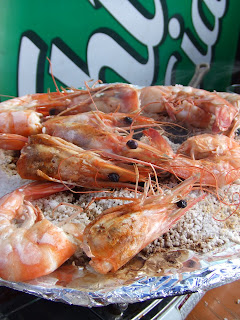
If you ever travel west from Seoul toward the coast, there are certain things you must have, especially in fall season. The coast is known for prawns (called daeha -- look at the size of those!) and crab. So if shellfish is your thing, that's the place to be. We had plenty of both (even though summer is usually the season for both, the heat -- yes, global warming -- extended it to fall) at a al-fresco restaurant overlooking the ocean crammed with people and massive tour buses. I didn't necessarily see the tour buses as a bad sign as I usually do. This was a recommendation from a guide book I trusted and I was going to eat there even if my life depended on it. It was Bogeum Hoegwan in Southern Choongcheong Province (or Choongnam).


I admit the prawns were a bit tough for the price, but were still good grilled on a bed of salt. The kicker, though, was the crab. First they served kyejang, which is raw crab marinated in a mix of soy sauce, garlic and other aromatics. I couldn't believe how meaty the crab was. It usually takes so much work to scoop out the flesh because the crabs are borderline anemic. But these had plenty of flesh to spare. Then they had kkotkyetang, which is a stew with crab, spices and some greens. Wow. Hope this doesn't offend anyone but the crabs were literally moving before they were dropped into the pot.


We made a pit stop at Dogo hot springs nearby and boy, did we find some gems. Both were recommended by locals. One was Chojeong Shikdang, a hole-in-the-wall in a small alley of restaurants that serves two things -- a beef broth soup boiled for hours from bones and cow head (known as someorikukbab) and a soup made from cow's blood and known to be a good remedy after a late night of drinking, sagolhaejangkuk. Neither may sound very appetizing and I'm no huge fan of cow head and other innards (not to mention blood), but I got to give it to them. The broth of the cow head soup was excellent -- complex and really tasting like bones and beef. Mix some rice, chopped green onions and salt and we're in business. We liked it so much we went back for breakfast back to back during our stay.


Another find was a restaurant catering exclusively to taxi drivers called Gohyangkisa Shikdang, loosely translating to Hometown Drivers' Restaurant. This place is also no-frills but I had very solid cheongkukjang, a stew much like duenjangjjigae using fermented soy bean paste with some vegetables and tofu. The difference is that the paste is a LOT stinkier than the regular paste of duenjang. Although different, it might help to say that cheongkukjang is to duenjang what nato is to Japanese miso. It's definitely an acquired taste but it easily became my favorite comfort food.


This area is known for its sweet potatoes and they are out of this world. At every stop on the road, local farmers sell them by the boxes at a bargain and hand you a few piping-hot ones cooked in those old-school devices with tiny round drawers circa 1970s.


Two restaurants I'd recommend in Seoul: Han Moe Chon and Ru, both near the Blue House. Han Moe Chon is a traditional jeongshik restaurant serving mostly vegetarian fare in a gorgeous setting reminiscent of a traditional Korean home. The lunch had many courses but my favorites were the acorn jelly topped with cucumbers and pine tree leaves seasoned with sesame oil and some red pepper flakes; and the braised duck wrapped in steamed cabbage leaves. The latter reminded me of the excellent pork belly and garlic leaf dish I had at Soseonje, although not quite as good. The namul or steamed and seasoned roots and vegetables were really fresh and unlike anything I've had in L.A.


The other one is Ru, which is slightly trendy but had interesting takes on traditional Korean food. Perched up on a hill overlooking an artsy neighborhood, the most interesting thing we had was very thin "noodles" made out of raw potatoes smothered in a black sesame sauce. It was refreshing and likely perfect for the summer months. It had the usual suspects of japchae (glass noodles with meat and vegetables in a soy and sesame oil sauce) and jeon (pancakes) as well as other more unusual offerings, such as tofu patties.


In conclusion, there were two things I had to have on this trip -- ttukbokki and just plain old ttuk. Both are rice cakes and variations of Korea's favorite dessert. One is a spicy snack that I can't seem to get a version of in a place like L.A. I also wanted all kinds of rice cakes, including the plain old white garaettuk (it's the block of ttuk used for ttuk guk eaten on New Year's Day), songpyun and many others.


I can't tell you how happy I was browsing through the food court area in the basement of Hyundai Department Store. Though the other items we bought at shops were bad, the ttukbokki, or rice cakes in spicy sauce with a boiled egg and noodles, was good. It hit the spot with its spiciness. I simply don't understand why it can't be replicated in L.A. I tried making at home to no avail.


Good rice cakes are hard to come by in America, so it was only natural that I hoarded all kinds of ttuk when I was introduced to a small shop in a new suburb called Bundang. It's called a View with Rice Cakes and is incredibly good. I baked the white rice cake in a toaster oven under high for a few minutes to get it crunchy and browned. I then dipped it in a soy sauce and sesame oil sauce before taking that immensely satisfying bite. Suffice it to say I still savor my rations of white rice cakes that I brought frozen from Korea.


Then there were the bean rice cakes that were conveniently wrapped individually and the songpyun, typically eaten during the Chusok Harvest holidays in fall. The rice cakes were soft and a bite squirted either a delicious honey and sesame seed mixture in its heart or just sesame seed paste that was equally nutty. I just about overdosed on them.

Hanwoori (한우리)
Kangnamgu Nonhyundong 91-18
(02) 545-3334

Jejuhang (제주항)
Kangnamgu Shinsadong 628-21
(02) 512-7071

Bogeum Hoegwan (복음회관)
Choongnam Taeangoon Anmyuneop Changkiri (Baeksajang Beach)
(041) 673-5349

Chojeung Shikdang (초정식당)
Choongnam Asanshi Dogomyun Kikokri 160-5
(041) 542-0359

Gohyangkisa Shikdang (고향기사식당)
Choongnam Yesangoon Yesaneup Kanyangri
(041) 334-8200

View with Rice Cake (떡이 있는 풍경)
Jeongjadong next to Citibank building
(031) 713-9494

Han Moe Chon (한뫼촌)
Jongrogu Jaedong 46-8
(02) 766-5535

Ru (루)
Jongrogu Samcheongdong 25-7
(02) 739-6771

*Whatever you do, make sure you stroll around any of these restaurants to check out the local neighborhoods. You may just discover another gem. Enjoy!

Saturday, November 1, 2008

Coast to Coast Dining Guide for Korea I


Since there were too many good places, I'll do a roundup of all the best eateries I experienced during this Korea trip in several installments. Most restaurants don't have Web sites so I'll link them to Korean blogs for those of you who speak Korean or just want to see more pictures.

Jaha Sonmandoo's specialty is dumplings. The restaurant is a converted house that sits on top a hill overlooking a beautiful view of the neighborhood near the Blue House. It's a bit tricky finding it but the trip is worth it. I had pyunsu, which are square dumplings containing beef and what sets it apart is it contains crunchy strips of cucumber, which is very refreshing and provides good texture.


The mandoo soup was a nice bowl of beef broth with large and round mandoo with some variation in color depending on what they added to the mandoo skin. I'm not sure what they add to the dough but it's likely pumpkin, spinach or strawberry water. The most memorable thing about this place was the combination with its just-ripe kimchi because it went so well with the garlicky and meaty taste of mandoo.


I traveled to Seoraksan by the East Sea to get some air and enjoy one of the most gorgeous foliage there is. Well, it was a bit early for foliage but I still got my share. Besides, the food and company were superb so I wasn't complaining. One of the first things I did when I arrived in Korea was to search religiously for food guides since I hadn't been back in a while. I wasn't disappointed. My first stop was, interestingly enough, not from any of the food guides except by our hotel's recommendation -- an impromptu find whose name escapes me (I think it was Seorak Sketch). It was jungshik, with a huge spread of side dishes and my personal favorite, the piping hot rice in a stone pot topped with all these goodies that are good for you -- chestnuts, jujubes, gingko nuts, etc.


The best was yet to come. We had excellent Korean-style Chinese food and a cornucopia of perfectly charred charcoal-grilled fish varieties the next few days.


Behold this perfect platter of crispy morsels of tender pork smothered in a sweet and sour sauce that has just the right amount of tanginess and sweetness. It's the classic tangsuyook and I daresay it was one of the best I've had. The restaurant, Wangbu, was originally in Seoul's trendy Samsungdong but its urban owners decided to move to the countryside where the air is better. I suspect the batter probably had corn starch to get that kind of ultra-crunchy texture. The sauce didn't drown the airy pork pieces but complemented them perfectly.


The even more classic Korean-style Chinese dish, jjajangmyun, noodles topped with jet black, glistening black bean sauce. The sauce had the usual zucchini, onions and pork. Samsun jjajang as opposed to Gan jjajang comes with shrimp and squid, but I prefer Gan jjajang for its simplicity. The noodles were chewy and I could taste the black bean flavor in the sauce. Many restaurants in Korea and L.A. mix too much caramel into the sauce to sweeten it and make it taste nasty, but Wangbu's sauce was just right.


I ordered the jjampong, a spicy seafood noodle soup that came highly recommended by my trusty guide book. The jjampong was definitely spicy in a good way. Even as a jjajangmyun person, I enjoyed it for its fresh seafood flavors and got my daily intake of vegetables.

The view wasn't bad either.


A real find was this true hole-in-the-wall smack in front of the Seokcho port that you can only get to through the narrowest of streets (no SUVs allowed). I mean, check out the contrasting view from this joint. At the busy dinner hour of around 7pm, 88 Sengsun Gooi was the only restaurant along the waterfront that any customers. I also noticed this was the only restaurant serving cooked fish as opposed to hoe, or sashimi, which Koreans love to consume near the ocean (live! straight from the tank!) but I'm not a huge fan of. Being a sushi/sashimi snob, the way the fish is cut in most Korean restaurants just doesn't "cut it" for me.


Each tiny table was equipped with a smoke absorber that slowly comes down to cover your tableside grill as soon as you sit down. The thing to order is mixed fish, which includes about half a dozen types of fish including sardine, squid, a flat gajami and the super oily mero, among others that I can't find translations for.


The fish was incredibly fresh -- so fresh that all it needed was salt and some serious charcoal to char it to perfection. Sampling a variety of fish was such a treat and for those who like spicy, the restaurant offered some soy sauce and wasabi as a dipping option. I tried both and while I appreciated the simple flavors of the fish seasoned only with salt, there was something to be said for the dipping sauce. I do like salty. I highly recommend this place.

Back in Seoul, I had excellent home-made bulgoki courtesy of HB. These stir-fried lovelies marinated in soy sauce and garlic, among other things were made even better by the addition of glass noodles and oyster mushrooms. Thanks HB! A recipe that I will definitely steal.


You may have to call most places to find them.

Jaha Sonmandoo
Jongroku Buamdong (on way to Book-ak Skyway)
02)379-2648, 394-4488

Wangbu
Seokchoshi Nohakdong 1000-7
(033) 635-6012

88 Sengsun Gooi
Seokchoshi Joongangdong 468-55 (by the waterfront)
(033) 633-8892

Sunday, October 19, 2008

Real Comfort Food and Pork Belly in Garlic Leaf


I've been busy gorging myself with incredible Korean food and learning, seeing and tasting all that Korea has to offer. It's been an amazing adventure so far.

It all started with the best of the best -- a home-cooked meal by none other than my Mom. It was comforting and just like I remembered it. A block of chunky, silvery kalchi fish seasoned only with salt and broiled; some boiled radish namul that's neutrally seasoned with salt, sesame seeds and sesame oil and of course, beef soup with radish squares.


Then on to one of my favorite restaurants in Seoul, the newly artsy Samchongdong near the Blue House, to be exact -- Sosonjae. Sosonjae loosely translates to "a place that serves simple food." It serves multi-course lunches with various price ranges. The greens salad had a refreshing dressing that was slightly citrusy and spicy (mustardy) at the same time. It's traditional Korean with a modern twist but not in a bad "fusion" kind of way. My personal favorite dish was the steamed pork belly slices that came with something I've never had before -- garlic leaves that had been pickled in a soy sauce-based liquid. Also accompanied was a stack of nappa cabbage pickled only with salt. The pickled garlic leaves were incredibly flavorful and perfect to wrap morsels of pork belly in -- topped with the nappa cabbage.


The jeon were good, except the seaweed pancake was a bit strange (also a first). Gujulpan, the mini-make-it-yourself burrito with a bunch of veggies was ok but I'm not a huge fan of the dish anyway. The kyejang, or raw crab marinated in soy sauce and garlic, was fresh and salty as it should be. The deep fried tofu pockets filled with minced mushrooms was not as flavorful as I've had it in other places. Still, this place is a winner, if nothing else for that garlic leaf-wrapped pork. It's a match made in heaven. It helped that the decor was serene and very conducive to shameless consumption.


For dessert, we headed to a place specializing in red bean porridge that calls itself "the place that serves the second best porridge" because the best must be your mom's. The porridge had been through a mixer so didn't have any grains, which I prefer (with grains, that is). And a bit too much cinnamon for my taste, but I liked the chestnut touch.


Sosonjae
Chongno-gu Samchong-dong 113-3, Seoul
(02) 730-7002

Place serving the second-best red bean porridge
Down the street from Sosonjae toward Kwanghwamoon

Sunday, September 28, 2008

Like Water for Mole


Here's a report on our semi-quarterly culinary trip around the world courtesy of Y and NJ's excellent adventures in the kitchen. We started off with Persian, then moved on to Italian with the Silver Spoon cookbook and ventured to Mexico this time. We both love to eat and cook, but we like to explore new ingredients and flavors as well. So we usually like to make things that get us out of our comfort zones (read: elaborate recipes with lots of ingredients we've never used before).

Enough of the foreword. Let's get to the meat of things -- the menu.


We started off with ripe plaintain turnovers with crab filling, made by my fearless partner in crime Y, which were good but her best dishes were definitely yet to come. I tend to go a bit crazy when it comes to offering "the whole package" to our guests so I made a huge pitcher of jamaica -- hibiscus flower water -- and horchata that can be made from a mix of almonds, sesame seeds, rice and/or barley (I used powder and water for both). And margaritas, of course, which I started off by measuring things and later just eyeballed to the delight of my guests.


The shrimp seviche served on beautiful lettuce leaves hugging the refreshing morsels of citrusy shrimp with crunchy red onions and creamy avocado chunks sprinkled with cilantro bits was the perfect starter to get the appetite going. We also had a decidedly non-Mexican salad (except for the crumbly Mexican queso fresco on top) inspired by a trip to South Carolina that was made even more delicious by the addition of watermelon cubes to the greens. Then came one of my favorite dishes of the evening -- chorizo-stuffed ancho chiles with sweet-sour escabeche. I'm usually not a huge chile relleno (stuffed chile) fan because I find the usual filling of cheese to be too, well, cheesy and heavy. So it was with much excitement we decided to try this recipe and boy, did Y nail it! The chiles were soft and smoky but retained their crunch at the same time. The best part was cutting into them to find a hearty mix of chorizo and potatoes. The icing on the cake was the refreshing escabeche, a sort of pickled topping, that balanced out the potential heaviness of the chorizo mix. This escabeche had sliced carrots and red onions cooked with garlic, vinegar and other spices -- the perfect accompaniment to the stuffed chile.


The onslaught of main dishes started pouring in, including ancho-marinated Oaxacan-style whole roast fish, Oaxacan black mole with chicken, braised pumpkin with pork, roasted vegetables in green sesame pipian, with the starch of choice being white rice and tomato rice. If these sound like unnecessarily long and complicated descriptions found at fancy restaurant menus, they are not meant to be (I trimmed a few down).

The black mole was one of the most labor intensive dishes I have ever made in my entire life. I'm glad it came out well in the end but I vowed this would be the first and last time I would make this dish from scratch. Not to mention the fact that I'm concerned about its less-than-healthy tendencies from all that charring and burning (notwithstanding its deliciousness).


The fish was tender, juicy and had just the right amount of kick in its sauce. The pumpkin dish was sweet from the pumpkin and spicy from the tomatillo-chipotle sauce. I wish I would have added more pork. It left me wanting more meat. Making the sesame seed-based pipian was a lot of fun. I got to cook with a funky green vegetable resembling a cucumber, chayote, cactus paddles (nopales) and the herb, epazote, for the first time and learned that Mexican cooking used a lot of sesame seeds. The sauce had a very unique taste that blended all these new flavors with a familiar one for me, that of sesame seeds. I would recommend it for anyone but especially for vegetarians looking for something different.


I made two kinds of rice as I wanted to make sure they would complement the dishes properly. I thought white would go better with mole and other heavily sauced dishes and tomato rice might go well with cleaner dishes such as the fish. The tomato rice was also spiced with jalapenos so it was important to have a neutral-tasting rice to balance out the strong flavors.


Overall, it was a success and we thank Rick Bayless's Mexican Kitchen cookbook. I had some reservations about going with a cookbook by a non-Mexican but who's to say a non-Mexican can't appreciate or make authentic Mexican food? And judging by his passion-filled PBS shows on the subject, I believe he is more than sincere in his quest to explore, promote and honor all things Mexican cuisine.


It was also fun eating leftovers the next morning -- transformed into the most comforting breakfast ever. Corn tortilla topped with a sunny side up, chorizo, tomato rice and a dab of home-made guacamole. Buen provecho!